
About
I am Mengyan Zhang (张梦妍), a lecturer (Assistant Professor) at the university of Bristol. Before that, I was a postdoctoral researcher at the University of Oxford, working with Prof. Seth Flaxman. I received my PhD at the Australian National University in 2023, under the supervision of Dr. Cheng Soon Ong, Prof. Lexing Xie and Prof. Eduardo Eyras. During my PhD, I was affiliated with Data61, CSIRO and interned at Microsoft Research Asia. I obtained my bachelor’s degree with first-class honours at the Australian National University and bachelor’s degree at Shandong University.
My research interests are sequential decision-making in machine learning, including Reinforcement learning, Bayesian optimisation and active learning. I work on both theoretical and practical views of experimental design with two goals: (I) Designing robust algorithms to handle imperfect feedback and understand causal relationships in sequential decision-making. (II) Designing decision-making algorithms to solve real-world problems in various areas, for example, synthetic biology, disease surveillance, survey design, and public policy.
Hiring - See Research Directions
I’m looking for highly motivated Ph.D. students who are excited about working on sequential decision making and its applications in health. We have an open funded PhD position: Learning and Decision-Making under Uncertainty in Public Health.
Required
- MSc in a relevant field (e.g., computer science, applied mathematics, statistics, bioinformatics)
- Strong background in machine learning/reinforcement learning
- Programming skills (Python, PyTorch)
Preferred
- Publication or open-source track record
- GPU / HPC experience
How to apply
Please email mengyan.zhang@bristol.ac.uk with [PhD Application + Your name] in the subject line, including:
- A CV;
- A Personal Statement, which is a one- to two-page document introducing yourself and outlining your motivation for PhD research;
- A transcript of any qualifying degrees (completed and/or underway);
- A research proposal (optional, but preferable);
- Any additional materials to support your application, e.g. research outputs, thesis, coding repository, etc.
Due to the volume of enquiries, only shortlisted candidates may receive a response.
Research & Publications/Preprint
-
Scalable Spatiotemporal Inference with Biased Scan Attention Transformer Neural Processes.
Daniel Jenson, Jhonathan Navott, Piotr Grynfelder, Mengyan Zhang, Makkunda Sharma, Elizaveta Semenova, Seth Flaxman (2026). International Conference on Artificial Intelligence and Statistics (AISTATS) 2026. {pre-print} -
Indirect Query Bayesian Optimization with Integrated Feedback.
Mengyan Zhang, Shahine Bouabid, Cheng Soon Ong, Seth Flaxman, Dino Sejdinovic (2026). ICML 2026 Workshop on Epistemic Intelligence in Machine Learning. {pre-print} -
Causal discovery methods in psychological research: Foundations, algorithms, and a practical tutorial in R.
Guangyu Zhu, Li Qian Tay, Mengyan Zhang (2026). Behavior Research Methods. {paper} -
Artificial intelligence for modelling infectious disease epidemics.
Moritz U. G. Kraemer, Joseph L.-H. Tsui, Serina Y. Chang, Spyros Lytras, Mark P. Khurana, Samantha Vanderslott, Sumali Bajaj, Neil Scheidwasser, Jacob Liam Curran-Sebastian, Elizaveta Semenova, Mengyan Zhang et al (2025). {Nature} -
Toward optimal disease surveillance with graph-based active learning.
Joseph L-H Tsui * , Mengyan Zhang * , Prathyush Sambaturu, Simon Busch-Moreno, Marc A Suchard, Oliver G Pybus, Seth Flaxman, Elizaveta Semenova, Moritz UG Kraemer (2024). {PNAS, epiDAMIK-KDD workshop 2024} -
Uncertainty-Aware Regression for Socio-Economic Estimation via Multi-View Remote Sensing.
Fan Yang, Sahoko Ishida, Mengyan Zhang, Daniel Jenson, Swapnil Mishra, Jhonathan Navott, Seth Flaxman (2024). {pre-print} -
Graph Agnostic Causal Bayesian Optimisation.
Sumantrak Mukherjee * , Mengyan Zhang * , Seth Flaxman, Sebastian Josef Vollmer (2024). NeurIPS Bayesian Decision-making and Uncertainty Workshop. -
PhD Thesis: Adaptive Recommendations with Bandit Feedback {ANU Open Research Library} (supervisors: Cheng Soon Ong, Lexing Xie, Eduardo Eyras) - Award: CORE Distinguished Dissertation Award Commendation
-
Two-Stage Neural Contextual Bandits for Personalised News Recommendation.
Mengyan Zhang, Thanh Nguyen-Tang, Fangzhao Wu, Zhenyu He, Xing Xie, Cheng Soon Ong. Under Review. {pre-print} -

Gaussian Process Bandits with Aggregated Feedback.
Mengyan Zhang, Russell Tsuchida, Cheng Soon Ong. AAAI 2022. {pre-print; code; poster; one-page abstract} -
Machine learning guided batched design of a bacterial Ribosome Binding Site.
Mengyan Zhang, Maciej Bartosz Holowko, Huw Hayman Zumpe, Cheng Soon Ong. ACS Synthetic Biology Journal 2022. {paper; C3DIS 2020 Talk; SEED 2021 Talk} -
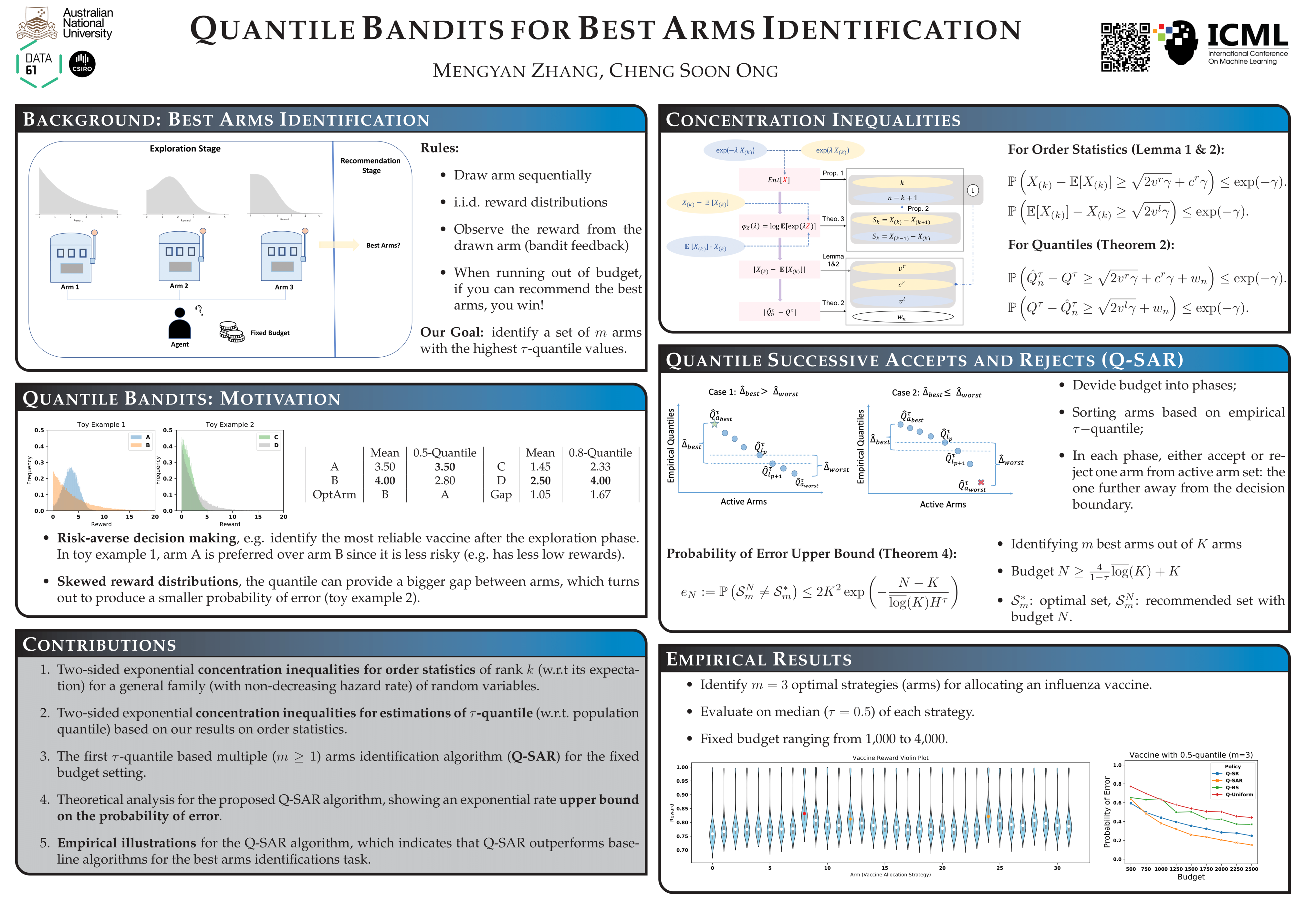
Quantile Bandits for Best Arms Identification.
Mengyan Zhang, Cheng Soon Ong. International Conference on Machine Learning 2021. {paper; code; poster; talk} -
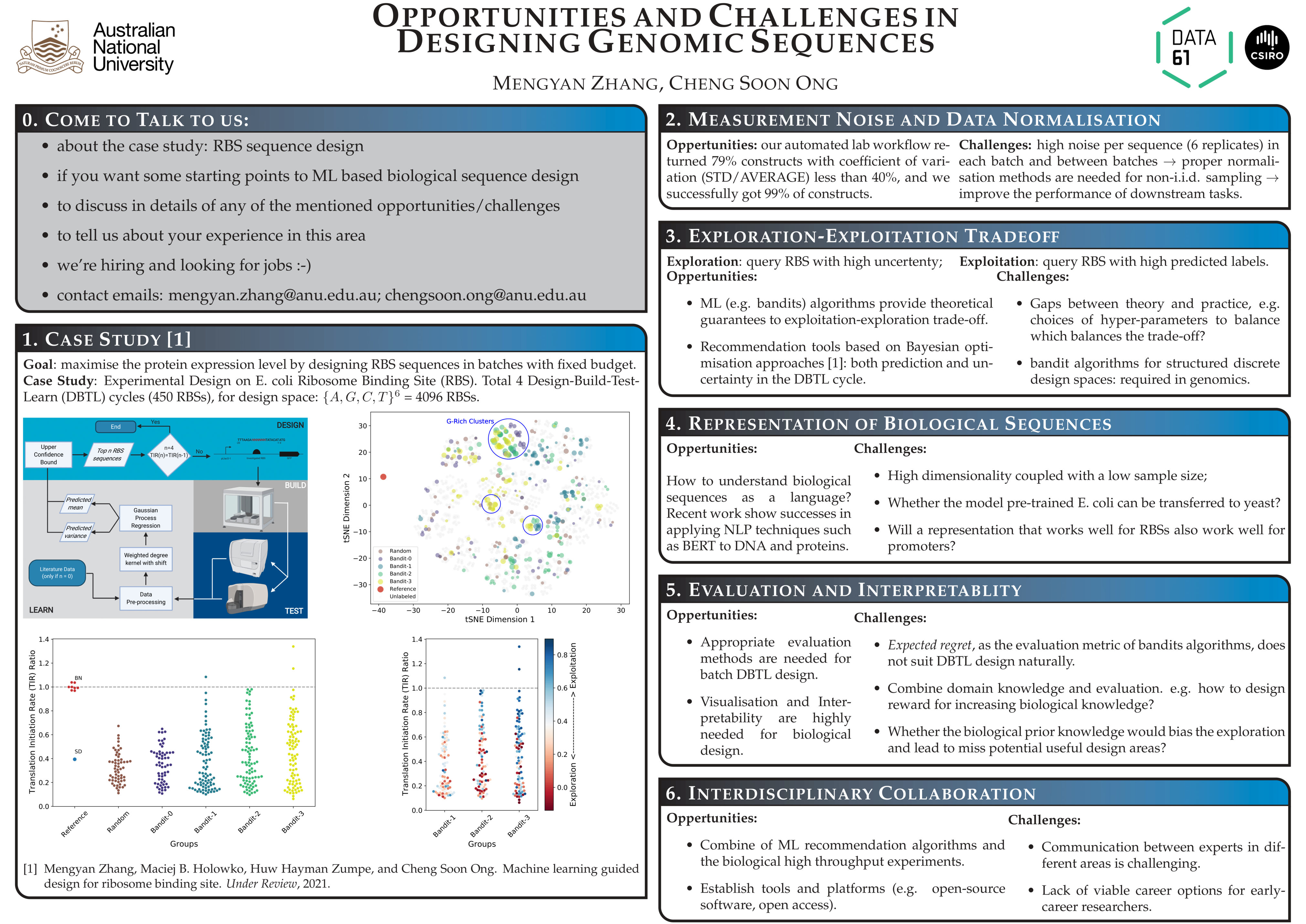
Opportunities and Challenges in Designing Genomic Sequences.
Mengyan Zhang, Cheng Soon Ong. ICML Workshop on Computational Biology 2021. {paper; poster; talk} -
Active Learning on Knowledge Graph. {software; flowchart; design}
Awards & Funding & Scholarship
- 2026 Global Positioning Fund, University of Bristol
- 2024 Award for Excellence at Oxford [top 10%]
- 2024 CORE Distinguished Dissertation Award Commendation (PhD thesis)
- 2024 NCCR Automation fellowship (Visiting ETH, up to CHF 18k)
- 2019 Data61 Top-up Postgraduate Research Scholarship
- 2018 PhD Scholarship of ANU
- 2018 ANU HDR Fee Remission Merit Scholarship
- 2017 Paul Thistlewatte Memorial Honours Year Scholarship of ANU
- 2015-2016 National Scholarship (China)
Teaching
- Unit Director & Lecturer: COMS20018 Introduction to AI, University of Bristol (TB1 2026/27)
- Lecturer: COMS30094 Intelligent Agents, University of Bristol (TB1 2026/27)
- Guest lecturer at RMIT Bioinformatics and Multi-omics data analysis (BIOL 2524) : introduction to ML and applications in biology (remotely, 3 lectures, May 2023) – course materials
- Tutor Statistical Machine Learning (S1 2019, S1 2020, S1 2021)
- Tutor Introduction to Machine Learning (S2 2020)
Talks & Presentations
- Sep. 2026 Organiser & speaker, AI for Health Predictions and Decision Intelligence workshop, AI4CI Hub, University of Bristol, UK
- Dec. 2025 CFECMStatistics Conference, King’s College London, London, UK
Sequential decision-making in public health. - Feb. 2024: LAS Group, ETH Zurich, Switzerland
slides: Sequential Decision-Making: Theory and Applications in Public Health - Dec. 2023: Google DeepMind, London
Design Choices in Sequential Decision-Making with Bandit Feedback - Nov. 2023: AIMS seminar, Oxford
Sequential decision making in public health - Nov. 2023: Bayes@CIRM Workshop, Marseille, France
Bayesian optimisation with aggregated feedback - Jul. 2023: University of Adelaide ADSC Seminar
Sequential Decision-making: Theory and Applications - Jun. 2022: ANU AI+ML+Friends seminar (PhD Completion Talk)
slides: Adaptive Recommendations with Bandit Feedback
Visit & Conferences
-
Research visit Swapnil Mishra at the Saw Swee Hock School of Public Health, National University of Singapore (NUS), Singapore.
-
Research visit Siu Lun Chau at the College of Computing and Data Science, Nanyang Technological University (NTU), Singapore.
-
Research visit Andreas Krause at Learning & Adaptive Systems (LAS) Group in ETH Zurich, Switzerland, via NCCR Automation Fellowship (Funded, up to CHF 20,000), Feb - April 2024.
-
Research visit Silvia Chiappa at Causal Intelligence Team, Google DeepMind, London, 6th Dec 2023.
-
Bayesian Statistic autumn school held at CIRM, Marseille, France, from 30 October to 3 November 2023.
- Research visit Prof. Dino Sejdinovic in the School of Computer and Mathematical Sciences at The University of Adelaide, July 2023.
- Reinforcement Learning Summer School (RLSS) 2023, June 26th to July 5th, 2023, Barcelona
- BioInference 2023, 8th-9th June 2023, University of Oxford
- Machine Learning Summer School (MLSS) 2020 at the Max Planck Institute for Intelligent Systems, Tübingen, Germany! (Acceptance rate 13.84%.)